
What is an MSE Wall? A complete guide to Mechanically Stabilized Earth.
Mechanically Stabilized Earth (MSE) is the modern engineering category that replaced concrete gravity retaining walls for almost every infrastructure use above 3 metres. This guide covers what it is, how it works, the four components, the history, and where it fits versus other retaining-wall systems Malaysian engineers consider.
What does MSE stand for?
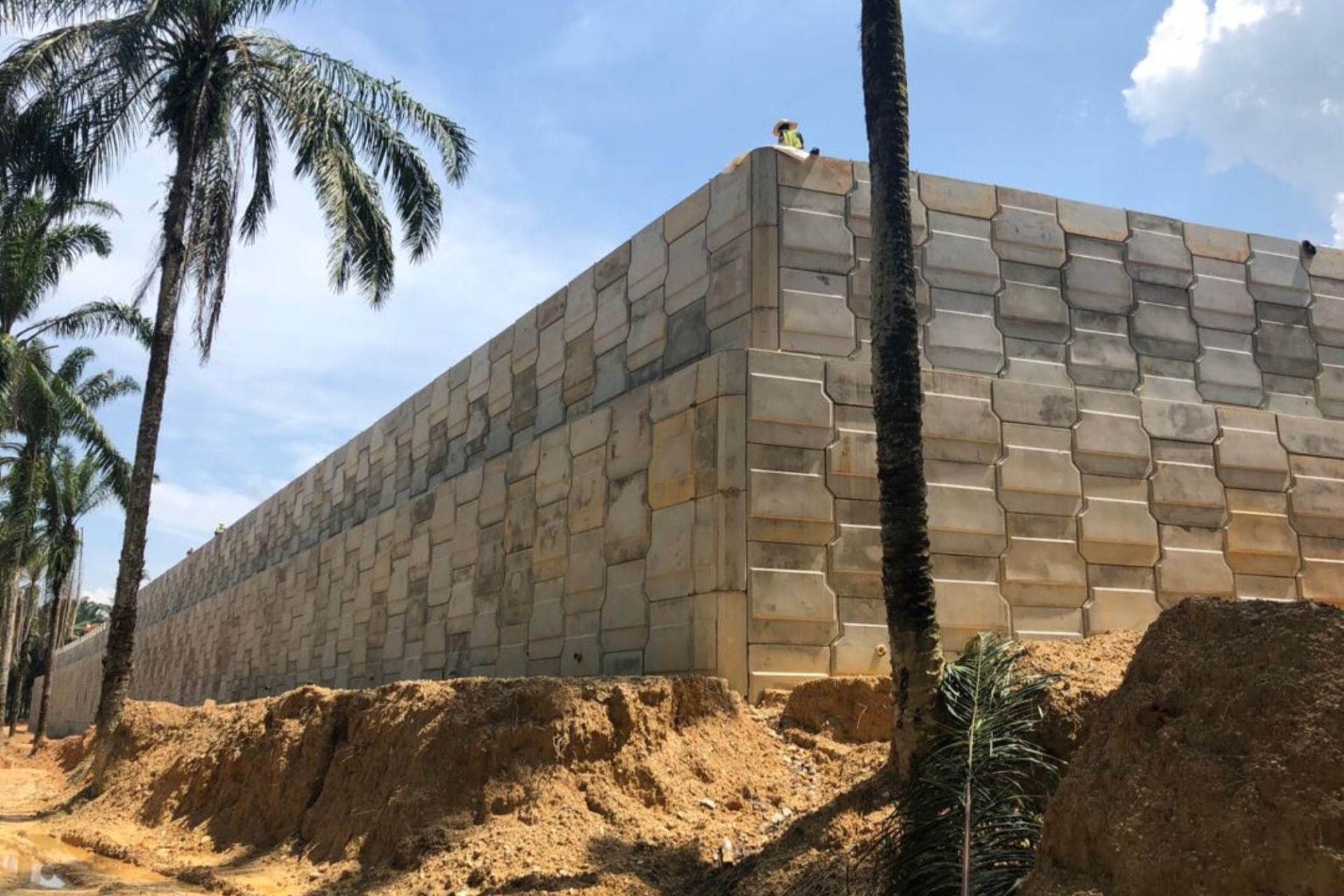
MSE stands for Mechanically Stabilized Earth. The term describes a class of retaining-wall systems in which the retained soil is internally reinforced with horizontal layers of tensile material (typically galvanised steel bars, steel strips, geogrids, or welded wire mesh) at regular vertical spacing. A precast concrete facing panel sits on the front face to hold the soil in alignment and protect against erosion.
The critical point: in an MSE wall, the retained soil is the wall. The reinforcement layers stitch the granular fill into a single composite block that resists both gravity and lateral earth pressure as if it were a solid gravity wall, while weighing a fraction as much and using a fraction of the concrete.
An MSE wall is not the same as a soil-nailed wall, a soldier-pile wall, or a gabion wall. Those are all separate categories of retaining structure. (Each has its own use cases; we will compare them in a later guide.) MSE is specifically about internal reinforcement of the retained soil mass.
How an MSE wall actually works
To understand the mechanics, picture a conventional reinforced concrete (RC) gravity wall. The concrete must be heavy enough to resist the lateral push of the soil behind it. As the wall grows taller, the lateral force grows quadratically with height, and the concrete required to resist it grows even faster. RC walls become uneconomic past about 5-7 metres in height.
MSE walls flip this problem. Instead of fighting the soil pressure with a heavy external mass, MSE walls recruit the retained soil itself to act as the resisting mass. Horizontal reinforcement layers, embedded inside the granular fill, distribute the tensile forces that would otherwise tear the soil apart. The resulting composite, soil plus reinforcement, behaves like a single gravity block, but built from material already on site.
The facing panels on the front of the wall do not carry the bulk of the load. Their primary job is to hold the soil surface in alignment, anchor the reinforcement layers, and provide a finished appearance. This is why MSE facing can be relatively thin precast concrete (typically 140-150 mm) rather than a massive concrete cross-section.
The four components of an MSE wall
Every MSE wall consists of four interacting components. The specifics vary between systems (strip-reinforced Reinforced Earth, geogrid-reinforced segmental block walls, anchored MSE walls like AnchorSOL®), but the four-component architecture is universal:
1. Precast concrete facing panel
A modular concrete element that forms the visible front face. Common shapes include inverted-T, octagonal, and cruciform. Each panel is cast in a controlled factory environment from Grade 30-40 MPa concrete. Architectural finishes (exposed aggregate, fluted, board-form, custom logo cast) are routinely available. Panels typically range from 1.5 m × 1.5 m up to 3 m × 1.5 m face dimensions.
2. Soil reinforcement
The tensile layers buried in the soil mass. Reinforcement can be:
- Galvanised steel strips (the original Reinforced Earth system, Vidal, 1960s)
- Galvanised deformed steel bars with deadman anchor blocks (anchored MSE systems like AnchorSOL®)
- Geogrids (extruded polyethylene or polyester sheet, common in segmental block walls)
- Welded wire mesh (typical of welded-wire-faced systems)
Inextensible reinforcement (steel) and extensible reinforcement (geosynthetics) behave differently and use different design assumptions per BS 8006 and FHWA NHI-10-024. Inextensible reinforcement gives less wall deformation, important for sensitive applications like bridge abutments.
3. Reinforced granular fill
The structural backfill placed in lifts between reinforcement layers. The fill must be cohesionless (clean granular, not clay), well-graded, and have a friction angle of ≥34° after compaction. In Malaysian practice, crusher run meets this specification at considerably lower cost than premium granular fill specified by some conventional MSE systems.
4. Deadman anchor block (anchored MSE only)
In anchored MSE walls (AnchorSOL® and other anchored MSE systems), a discrete precast block at the far end of each reinforcement bar provides the bulk of the pullout resistance. This is the key mechanical distinction between anchored MSE and conventional (friction-only) MSE: load transfer concentrates at the deadman, allowing the reinforcement zone to use lower-spec backfill.
Where MSE walls came from
Modern MSE walls trace to French civil engineer Henri Vidal in 1963. Vidal patented "Terre Armée" (Reinforced Earth), the first commercial MSE wall system, using galvanised steel strips. The first major application was the A53 expressway in southern France in 1968.
The technology entered the United States in 1972, with FHWA adopting it as a standard infrastructure solution by the mid-1970s. By 1990, MSE walls had largely displaced reinforced concrete gravity walls on US federal highway projects above 3 metres. Today MSE walls are the default retaining-wall solution for highway, bridge, and rail infrastructure worldwide.
The anchored variant, which AnchorSOL® builds in Malaysia, developed in parallel from the 1990s. It uses discrete deadman anchor blocks instead of distributed friction along the reinforcement length, allowing lower-spec backfill and somewhat different design assumptions. Academic validation of anchored MSE mechanics has been published in journals including the American Journal of Environmental Sciences, Scientific Research and Essays, and the Sri Lanka Journal of Engineering.
Modern variants: strip, grid, anchored
Three reinforcement architectures dominate the MSE market today:
| Architecture | Reinforcement | Pullout mechanism | Typical backfill |
|---|---|---|---|
| Strip-reinforced (Reinforced Earth, Vidal) | Galvanised steel strips | Friction along strip | Premium granular (specified) |
| Geogrid-reinforced (segmental block walls) | Polymer geogrid sheets | Soil-grid interlock | Granular or fine-grained |
| Anchored MSE (AnchorSOL®) | Galvanised steel bar + deadman block | Passive resistance at deadman | Crusher run or local granular |
The anchored variant has practical advantages on Malaysian sites: it tolerates lower-spec backfill, requires no heavy compaction plant inside the reinforced zone (hand or mini-compactor only), and is engineered for the specific failure mechanism rather than relying on side-friction along long strips.
Where MSE walls are used in Malaysia
MSE walls are now the standard solution for any retaining-wall application above 3 metres on Malaysian infrastructure projects. Typical use cases include:
- Highway embankments, federal roads (JKR), expressways (PLUS), state roads
- Bridge abutments, supporting bridge decks at the end transition from earthworks to structure
- Hill stabilisation, stepped retention on slopes, common in Selangor and Perak terrain
- Marine and riverbank protection, tide-line retention, riverbank reinforcement, drainage headwalls
- Under-railway support, sub-track embankments under KTMB rail corridors
- Residential and commercial site development, boundary retention, terraced platforms, basement retention
- Industrial bulk storage, circular tank-containment ring walls
AnchorSOL® has delivered over 500 walls across these applications since 1999. See selected projects →
Building a wall? Talk to us.
500+ named projects since 1999. Anchored MSE, RE, RS, RC retaining walls. Specified by JKR, PLUS, KTMB, LLM.
When MSE beats reinforced concrete
The short answer: almost always, above 3 metres. The long answer:
- Below 3 m: RC gravity walls and segmental block walls are usually cheaper. MSE has higher fixed costs (precast panels, reinforcement, engineering) that don't amortise on small jobs.
- 3 to 5 m: RC and MSE are roughly cost-equivalent. The decision depends on site access, timeline, aesthetic requirements, and contractor preference.
- 5 to 10 m: MSE is typically 20-40% cheaper than RC and 2-4× faster to build.
- Above 10 m: MSE is the only economically practical solution. RC walls of this height require massive footings, heavy formwork, and multi-week curing cycles that push project programmes by months.
We cover this in detail in our dedicated guide: MSE Wall vs RC Wall: Cost, Build, Programme →
Cost economics in the Malaysian market
Costs vary by wall height, site access, soil conditions, and finish specification, but typical 2026 Malaysian benchmarks for an anchored MSE wall like AnchorSOL® are:
- 5 m wall: ~RM 750-1,100 per square metre of wall face
- 10 m wall: ~RM 1,100-1,500 per square metre of wall face
- 15 m wall: ~RM 1,400-1,900 per square metre of wall face
These figures include precast panels, reinforcement, deadman blocks, granular backfill, installation labour, and a typical engineering allocation. They exclude earthworks, drainage, ground improvement, and any architectural finish premium. Get a project-specific quote: contact AnchorSOL® →
Comparable RC retaining walls at the same heights typically run 30-80% higher per square metre once you include formwork, curing time, and programme impact.
Service life and durability
MSE walls are designed for a service life of 75 to 100+ years, with three primary durability concerns:
- Reinforcement corrosion. Hot-dip galvanised steel bars (75-85 µm zinc coating) with a sacrificial-thickness design allowance, plus controlled backfill chemistry (pH, chloride content), give 100+ year design lives. Polymer reinforcements have separate durability protocols.
- Facing panel longevity. Grade 30 MPa precast concrete with proper cover meets BS 8500 / EN 206 for the 100-year design life in normal exposure classes.
- Backfill quality. Maintaining granular fill specification (friction angle ≥34°, no clay contamination) over the design life requires correct construction QC.
AnchorSOL®'s oldest in-service walls date to 1999 and have shown no measurable distress.
Design standards Malaysian engineers cite
MSE walls in Malaysia are designed to a combination of international and local standards. The most-cited:
- BS 8006-1:2010, Code of practice for strengthened/reinforced soils and other fills. The UK standard, widely used in Malaysian practice.
- FHWA NHI-10-024, Design of MSE Walls and Reinforced Soil Slopes. The US Federal Highway Administration's design manual, often cited for technical detail.
- JKR Standard Specification, Public Works Department requirements for federal road projects.
- EN 14475, European execution standard for reinforced fill structures.
FAQ
What does MSE stand for?
MSE stands for Mechanically Stabilized Earth. It is a category of retaining-wall systems in which the retained soil is internally reinforced (with steel or geosynthetic layers) to form a composite gravity block. The reinforced soil is the wall.
Who invented the MSE wall?
Henri Vidal, a French civil engineer, in 1963. His commercial system, marketed as Terre Armée (Reinforced Earth), used galvanised steel strips and saw its first major application on the A53 expressway in southern France in 1968.
How tall can MSE walls be?
3 metres at the lower end to over 30 metres at the upper end. Above 3 metres, MSE walls are typically more cost-effective than reinforced concrete; above 10 metres, MSE is usually the only economically practical option.
How long do MSE walls last?
MSE walls are designed for 75 to 100+ years of service life. AnchorSOL®'s oldest in-service walls have been in place since 1999 with no measurable distress.
Is MSE wall the same as Reinforced Earth?
Reinforced Earth is the original system (Henri Vidal, 1963) within the MSE category. MSE is the broader category; Reinforced Earth, AnchorSOL®, and various other soil-reinforcement systems are all variations within the category.
Can MSE walls be built on soft ground?
Yes, with appropriate ground improvement. The flexible-interface panel system in anchored MSE walls (AnchorSOL®) tolerates differential settlement better than rigid RC structures. Common ground improvement strategies include preloading, prefabricated vertical drains, and stone columns.